

Licensed Character Packaging for Toddler Toys Market to Grow at 11.5% CAGR Through 2036 Amid IP Expansion
Licensed Character Packaging for Toddler Toys Market
Licensed character packaging for toddler toys market expands rapidly, driven by IP monetization, compliance governance, and omnichannel retail demands.
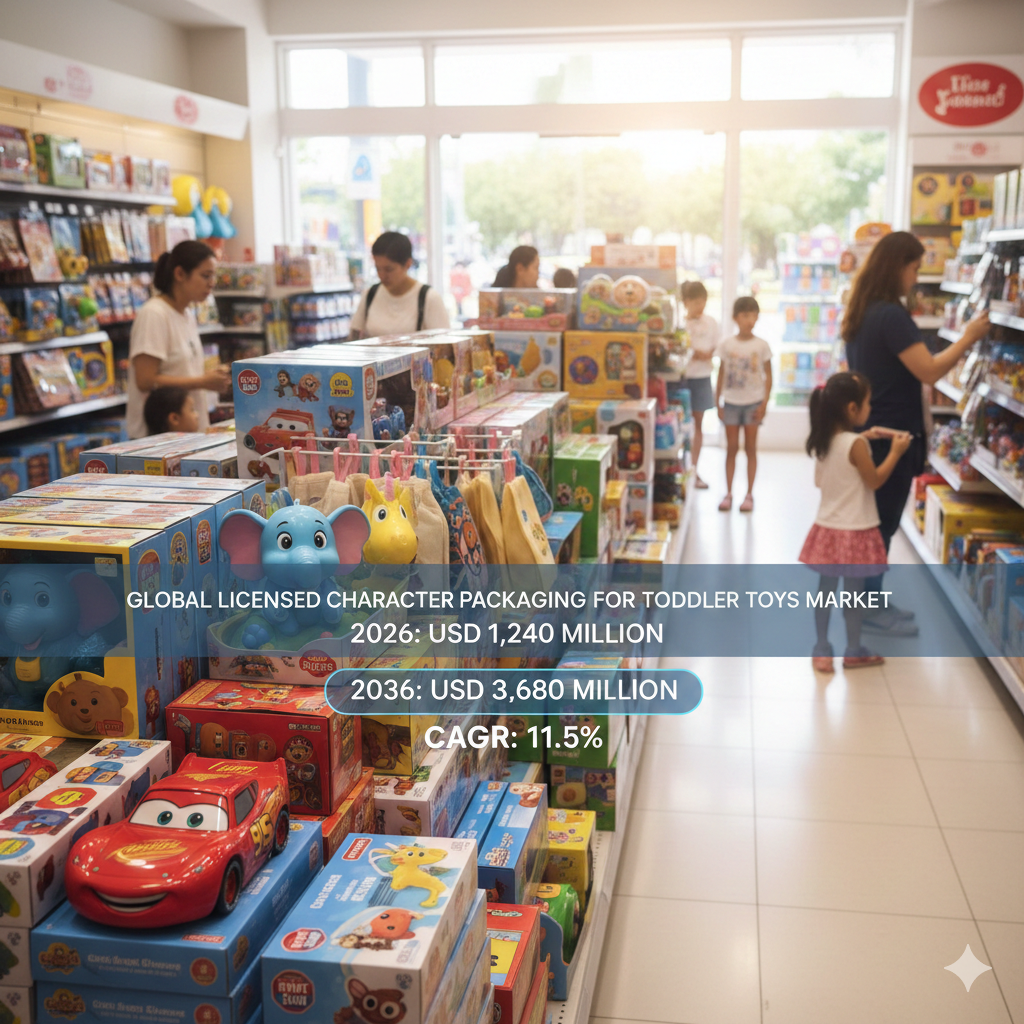
NEWARK, DE, UNITED STATES, February 16, 2026 /EINPresswire.com/ -- The global licensed character packaging for toddler toys market is projected to grow from USD 1,240 million in 2026 to USD 3,680 million by 2036, registering a robust CAGR of 11.5%. According to Future Market Insights (FMI), structural expansion is being driven by deeper monetization of licensed intellectual property (IP) in early-age categories and the rising packaging intensity of character-driven portfolios.
Packaging in this segment is no longer a passive protective layer. It acts as a conversion asset—directly influencing shelf visibility, gifting preference, brand recall, and age-appropriate communication. As licensed toddler SKUs multiply across global retail channels, packaging becomes a scalable commercial interface between licensors, brands, and consumers.
Request For Sample Report | Customize Report | Purchase Full Report - https://www.futuremarketinsights.com/reports/sample/rep-gb-32025
FMI analysis highlights that growth is increasingly tied to packaging platform standardization. Character lines refresh frequently, but the underlying packaging “platform”—including dielines, structural geometry, and artwork zones—is being engineered for repeatable deployment across multiple SKUs and geographies. This reduces redesign churn, shortens approval cycles, and enhances production efficiency.
Market at a Glance
• Market Value 2026: USD 1,240 million
• Forecast Value 2036: USD 3,680 million
• CAGR (2026–2036): 11.5%
• Largest Regional Share: North America (34%)
• Fastest Growing Country: India (14.8% CAGR)
Source: FMI proprietary forecasting model and primary research
Why Is the Market Growing?
The primary growth engine is the packaging intensity of licensed toddler toy portfolios. Licensed SKUs depend heavily on packaging to communicate character authenticity, maintain color fidelity, and create visual differentiation at shelf. Compared to unlicensed toys, licensed products generate higher packaging value per unit due to stringent artwork standards and compliance labeling requirements.
A second growth factor is omnichannel convergence. Packaging must simultaneously perform in:
• Big-box retail environments requiring high shelf impact and planogram fit
• E-commerce fulfillment systems demanding damage resistance and ship readiness
This dual pressure is narrowing format choices toward scalable, structurally durable packaging architectures.
Compliance governance further reinforces market discipline. In the European Union, stronger toy safety requirements effective January 2026 elevate documentation, labeling precision, and packaging execution standards. In the United States, choking hazard labeling and small-parts regulations increase the need for consistent age grading and warning communication across packaging and advertising touchpoints.
Segment Insights
End Use: Big-Box Retail Leads (38%)
Big-box retail dominates due to its volume throughput and strict shelf-performance metrics. Licensed toddler toys depend on rapid character recognition, and retail environments reward packaging that delivers high-impact artwork and standardized footprint performance.
Operational standardization is equally critical. Retailers prioritize repeatable pack sizes, stable stacking, and predictable replenishment, favoring suppliers that deliver consistent die-cut quality and print reproduction across high-volume runs.
Packaging Format: Window Boxes (34%)
Window boxes lead as they combine character artwork visibility with direct product display. For caregivers purchasing toddler toys, product visibility paired with trusted character IP enhances conversion probability.
Additionally, window boxes offer structured zones for warnings, age grading, and authentication elements—reducing execution variance across multi-SKU programs.
Material: SBS Paperboard (42%)
Solid bleached sulfate (SBS) paperboard dominates due to its superior print sensitivity. Licensed character artwork demands color accuracy, sharp line reproduction, and scuff resistance. SBS offers stable converting behavior and predictable structural stiffness—supporting premium shelf appearance and fulfillment durability.
Regional Outlook
North America (34% Share) retains leadership due to strong licensed-IP penetration and big-box retail dominance. Mature compliance communication standards reinforce demand for disciplined packaging execution.
India (14.8% CAGR) is the fastest-growing market, supported by organized retail expansion and rising licensed character penetration. Packaging increasingly serves as a brand-control mechanism to reduce counterfeiting and execution variance.
China (13.6% CAGR) benefits from scale manufacturing and rapid character refresh cycles. High-volume production favors standardized packaging formats that maintain artwork integrity while enabling quick turnaround.
Germany (10.2% CAGR) advances through strict EU compliance expectations and retail governance, while Japan (9.4% CAGR) emphasizes quality-led execution and print precision. Brazil (11.0% CAGR) sees growth through mainstream retail expansion and licensed SKU proliferation.
Competitive Landscape
The market is defined by execution capability rather than commodity capacity. Competitive advantage hinges on:
• Licensing-grade print fidelity and color control
• Repeatable dieline systems and modular packaging platforms
• Omnichannel durability combining shelf performance with shipping resilience
Key players include Berry Global, Graphic Packaging, Smurfit Kappa, DS Smith, Nine Dragons, Greatview, Toppan, Rengo, ITC Packaging, and Amcor. Suppliers that reduce licensor approval friction and ensure consistent pack geometry across regions gain structural advantage.
Key Market Trends
• Increasing governance and packaging defensibility
• Standardization of artwork zones and compliance layouts
• Reduced redesign churn across character refresh cycles
• Concentration around scalable packaging architectures
The highest-value opportunity lies in platform standardization—reusable structural templates that enable rapid rollout across retailers and geographies without repeated redesign cycles.
FAQs
Q1. What is driving growth in licensed character packaging for toddler toys?
Growth is driven by licensed IP monetization, packaging intensity per SKU, omnichannel retail requirements, and stricter compliance governance.
Q2. Which region holds the largest share?
North America leads due to strong retail infrastructure and high licensed-IP penetration.
Q3. Which country is growing fastest?
India records the fastest CAGR at 14.8% through 2036.
Q4. What packaging format is most preferred?
Window boxes dominate due to combined product visibility and character merchandising impact.
Q5. What material leads the market?
SBS paperboard leads owing to high print fidelity and structural consistency.
Browse Related Insights
Multi-Pack Packaging for Toddler Toys Market: https://www.futuremarketinsights.com/reports/multi-pack-packaging-for-toddler-toys-market
Instructional Packaging for Toddler Toys Market: https://www.futuremarketinsights.com/reports/instructional-packaging-for-toddler-toys-market
Wooden Toddler Toy Packaging Market: https://www.futuremarketinsights.com/reports/wooden-toddler-toy-packaging-market
About Future Market Insights (FMI)
Future Market Insights, Inc. (FMI) is an ESOMAR-certified, ISO 9001:2015 market research and consulting organization, trusted by Fortune 500 clients and global enterprises. With operations in the U.S., UK, India, and Dubai, FMI provides data-backed insights and strategic intelligence across 30+ industries and 1200 markets worldwide.
Sudip Saha
Future Market Insights Inc.
+18455795705 ext.
email us here
Legal Disclaimer:
EIN Presswire provides this news content "as is" without warranty of any kind. We do not accept any responsibility or liability for the accuracy, content, images, videos, licenses, completeness, legality, or reliability of the information contained in this article. If you have any complaints or copyright issues related to this article, kindly contact the author above.
